

What Determines An Organism's Phenptype What Is The Physical Makeup Of An Org
 | Look upwards phenotype in Wiktionary, the free dictionary. |

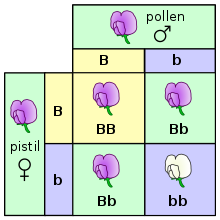
Here the relation betwixt genotype and phenotype is illustrated, using a Punnett square, for the character of petal color in pea plants. The letters B and b stand for genes for color, and the pictures prove the resultant phenotypes. This shows how multiple genotypes (BB and Bb) may yield the same phenotype (imperial petals).
In genetics, the phenotype (from Ancient Greek φαίνω ( phaínō ) 'to appear, show, shine', and τύπος ( túpos ) 'mark, blazon') is the ready of appreciable characteristics or traits of an organism.[ane] [two] The term covers the organism's morphology or physical form and structure, its developmental processes, its biochemical and physiological properties, its behavior, and the products of beliefs. An organism's phenotype results from 2 basic factors: the expression of an organism's genetic lawmaking, or its genotype, and the influence of environmental factors. Both factors may collaborate, farther affecting phenotype. When ii or more conspicuously different phenotypes exist in the same population of a species, the species is called polymorphic. A well-documented example of polymorphism is Labrador Retriever coloring; while the coat colour depends on many genes, information technology is clearly seen in the environs as xanthous, black, and dark-brown. Richard Dawkins in 1978[iii] then once more in his 1982 book The Extended Phenotype suggested that one can regard bird nests and other built structures such as caddis-fly larva cases and beaver dams every bit "extended phenotypes".
Wilhelm Johannsen proposed the genotype–phenotype distinction in 1911 to brand clear the divergence between an organism'south heredity and what that heredity produces.[4] [5] The distinction resembles that proposed past August Weismann (1834–1914), who distinguished between germ plasm (heredity) and somatic cells (the body).
The genotype–phenotype distinction should not exist confused with Francis Crick's central dogma of molecular biology, a statement about the directionality of molecular sequential information flowing from DNA to protein, and non the reverse.
Difficulties in definition [edit]
Despite its seemingly straightforward definition, the concept of the phenotype has hidden subtleties. It may seem that anything dependent on the genotype is a phenotype, including molecules such every bit RNA and proteins. Nearly molecules and structures coded by the genetic material are not visible in the appearance of an organism, yet they are observable (for example past Western blotting) and are thus function of the phenotype; human claret groups are an example. It may seem that this goes beyond the original intentions of the concept with its focus on the (living) organism in itself. Either manner, the term phenotype includes inherent traits or characteristics that are observable or traits that tin be made visible by some technical procedure. A notable extension to this idea is the presence of "organic molecules" or metabolites that are generated by organisms from chemical reactions of enzymes.

ABO blood groups determined through a Punnett square and displaying phenotypes and genotypes
The term "phenotype" has sometimes been incorrectly used every bit a autograph for the phenotypic difference between a mutant and its wild type, which (if non pregnant) leads to the argument that a "mutation has no phenotype".[6]
Another extension adds behavior to the phenotype, since behaviors are observable characteristics. Behavioral phenotypes include cognitive, personality, and behavioral patterns. Some behavioral phenotypes may characterize psychiatric disorders[7] or syndromes.[8] [9]
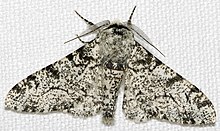
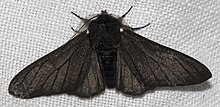
B.betularia morpha carbonaria, the melanic form, illustrating discontinuous variation
Phenotypic variation [edit]
Phenotypic variation (due to underlying heritable genetic variation) is a key prerequisite for evolution past natural selection. Information technology is the living organism every bit a whole that contributes (or not) to the next generation, so natural selection affects the genetic construction of a population indirectly via the contribution of phenotypes. Without phenotypic variation, at that place would exist no evolution by natural option.[10]
The interaction betwixt genotype and phenotype has often been conceptualized past the following relationship:
- genotype (G) + environment (E) → phenotype (P)
A more than nuanced version of the relationship is:
- genotype (G) + environment (E) + genotype & environment interactions (GE) → phenotype (P)
Genotypes often have much flexibility in the modification and expression of phenotypes; in many organisms these phenotypes are very dissimilar under varying ecology conditions (see ecophenotypic variation). The plant Hieracium umbellatum is plant growing in 2 unlike habitats in Sweden. One habitat is rocky, sea-side cliffs, where the plants are bushy with wide leaves and expanded inflorescences; the other is among sand dunes where the plants abound prostrate with narrow leaves and compact inflorescences. These habitats alternate along the coast of Sweden and the habitat that the seeds of Hieracium umbellatum land in, determine the phenotype that grows.[11]
An instance of random variation in Drosophila flies is the number of ommatidia, which may vary (randomly) betwixt left and right eyes in a single individual as much as they do between different genotypes overall, or betwixt clones raised in different environments.[ citation needed ]
The concept of phenotype can be extended to variations below the level of the gene that bear on an organism's fitness. For example, silent mutations that practice non change the corresponding amino acid sequence of a cistron may alter the frequency of guanine-cytosine base of operations pairs (GC content). These base of operations pairs accept a higher thermal stability (melting point) than adenine-thymine, a property that might convey, amidst organisms living in high-temperature environments, a selective advantage on variants enriched in GC content.[ citation needed ]
The extended phenotype [edit]
Richard Dawkins described a phenotype that included all effects that a cistron has on its surroundings, including other organisms, as an extended phenotype, arguing that "An creature'due south beliefs tends to maximize the survival of the genes 'for' that behavior, whether or non those genes happen to exist in the body of the particular beast performing it."[iii] For case, an organism such as a beaver modifies its surround by building a beaver dam; this can exist considered an expression of its genes, only as its incisor teeth are—which it uses to modify its surround. Similarly, when a bird feeds a brood parasite such as a cuckoo, it is unwittingly extending its phenotype; and when genes in an orchid affect orchid bee beliefs to increase pollination, or when genes in a peacock affect the copulatory decisions of peahens, again, the phenotype is being extended. Genes are, in Dawkins's view, selected past their phenotypic effects.[12]
Other biologists broadly concord that the extended phenotype concept is relevant, just consider that its role is largely explanatory, rather than assisting in the design of experimental tests.[13]
Phenome and phenomics [edit]
Although a phenotype is the ensemble of appreciable characteristics displayed by an organism, the word phenome is sometimes used to refer to a collection of traits, while the simultaneous study of such a collection is referred to as phenomics.[14] [15] Phenomics is an important field of study because it can be used to figure out which genomic variants affect phenotypes which then can be used to explain things like health, illness, and evolutionary fitness.[xvi] Phenomics forms a big part of the Human Genome Project[17]
Phenomics has applications in agriculture. For instance, genomic variations such as drought and estrus resistance can be identified through phenomics to create more durable GMOs.[xviii] [19]
Phenomics may be a stepping rock towards personalized medicine, particularly drug therapy.[xx] Once the phenomic database has acquired more data, a person'south phenomic information can be used to select specific drugs tailored to an individual.[twenty]
Big-scale phenotyping and genetic screens [edit]
Big-calibration genetic screens can place the genes or mutations that bear on the phenotype of an organism. Analyzing the phenotypes of mutant genes can besides assistance in determining gene function.[21] For example, a large-scale phenotypic screen has been used to study bottom understood phenotypes such as beliefs. In this screen, the office of mutations in mice were studied in areas such as learning and memory, circadian rhythmicity, vision, responses to stress and response to psychostimulants (see table for details).
| Phenotypic Domain | Analysis | Notes | Software Package |
|---|---|---|---|
| Circadian Rhythm | Wheel running behavior | ClockLab | |
| Learning and Memory | Fear conditioning | Video-epitome-based scoring of freezing | FreezeFrame |
| Preliminary Assessment | Open field activity and elevated plus maze | Video-image-based scoring of exploration | LimeLight |
| Psychostimulant response | Hyperlocomotion beliefs | Video-image-based tracking of locomotion | BigBrother |
| Vision | Electroretinogram and Fundus photography | Fifty. Pinto and colleagues |
This experiment involved the progeny of mice treated with ENU, or Northward-ethyl-N-nitrosourea, which is a potent mutagen that causes point mutations. The mice were phenotypically screened for alterations in the dissimilar behavioral domains in order to notice the number of putative mutants (come across table for details). Putative mutants are and then tested for heritability in guild to aid determine the inheritance pattern besides as map out the mutations. Once they have been mapped out, cloned, and identified, it tin can be determined whether a mutation represents a new gene or not.
| Phenotypic domain | ENU Progeny screened | Putative mutants | Putative mutant lines with progeny | Confirmed mutants |
|---|---|---|---|---|
| General assessment | 29860 | 80 | 38 | 14 |
| Learning and memory | 23123 | 165 | 106 | xix |
| Psychostimulant response | 20997 | 168 | 86 | 9 |
| Neuroendocrine response to stress | 13118 | 126 | 54 | 2 |
| Vision | 15582 | 108 | 60 | 6 |
These experiments showed that mutations in the rhodopsin gene affected vision and can even cause retinal degeneration in mice.[22] The same amino acid modify causes man familial blindness, showing how phenotyping in animals can inform medical diagnostics and possibly therapy.
Evolutionary origin of phenotype [edit]
The RNA world is the hypothesized pre-cellular stage in the evolutionary history of life on world, in which self-replicating RNA molecules proliferated prior to the evolution of Dna and proteins.[23] The folded three-dimensional physical structure of the start RNA molecule that possessed ribozyme activity promoting replication while fugitive devastation would have been the starting time phenotype, and the nucleotide sequence of the first cocky-replicating RNA molecule would have been the original genotype.[23]
See as well [edit]
- Ecotype
- Endophenotype
- Genotype
- Genotype-phenotype stardom
- Molecular phenotyping
- Race and genetics
References [edit]
- ^ "phenotype adjective – Definition, pictures, pronunciation and usage notes". Oxford Avant-garde Learner's Dictionary at OxfordLearnersDictionaries.com . Retrieved 2020-04-29 .
the fix of observable characteristics of an individual resulting from the interaction of its genotype with the environment.
- ^ "Genotype versus phenotype". Understanding Evolution . Retrieved 2020-04-29 .
An organism's genotype is the set of genes that information technology carries. An organism's phenotype is all of its observable characteristics — which are influenced both by its genotype and past the environs.
- ^ a b Dawkins R (May 1978). "Replicator selection and the extended phenotype". Zeitschrift Fur Tierpsychologie. 47 (1): 61–76. doi:x.1111/j.1439-0310.1978.tb01823.10. PMID 696023.
- ^ Churchill FB (1974). "William Johannsen and the genotype concept". Periodical of the History of Biological science. 7 (1): 5–thirty. doi:10.1007/BF00179291. PMID 11610096. S2CID 38649212.
- ^ Johannsen West (August 2014). "The genotype formulation of heredity. 1911". International Periodical of Epidemiology. 43 (4): 989–yard. doi:10.1086/279202. JSTOR 2455747. PMC4258772. PMID 24691957.
- ^ Crusio We (May 2002). "'My mouse has no phenotype'". Genes, Brain, and Behavior. 1 (two): 71. doi:10.1034/j.1601-183X.2002.10201.x. PMID 12884976. S2CID 35382304.
- ^ Cassidy SB, Morris CA (2002-01-01). "Behavioral phenotypes in genetic syndromes: genetic clues to human behavior". Advances in Pediatrics. 49: 59–86. PMID 12214780.
- ^ O'Brien G, Yule W, eds. (1995). Behavioural Phenotype. Clinics in Developmental Medicine No.138. London: Mac Keith Press. ISBN978-one-898683-06-iii.
- ^ O'Brien, Gregory, ed. (2002). Behavioural Phenotypes in Clinical Practice. London: Mac Keith Press. ISBN978-1-898683-27-8 . Retrieved 27 September 2010.
- ^ Lewontin RC (November 1970). "The Units of Selection" (PDF). Annual Review of Ecology and Systematics. ane: 1–18. doi:x.1146/annurev.es.01.110170.000245. JSTOR 2096764.
- ^ "Botany online: Evolution: The Mod Synthesis - Phenotypic and Genetic Variation; Ecotypes". Archived from the original on 2009-06-18. Retrieved 2009-12-29 .
- ^ Dawkins R (1982). The Extended Phenotype. Oxford Academy. p. 4. ISBN978-0-19-288051-2.
- ^ Hunter P (March 2009). "Extended phenotype redux. How far can the achieve of genes extend in manipulating the environment of an organism?". EMBO Reports. 10 (3): 212–215. doi:x.1038/embor.2009.xviii. PMC2658563. PMID 19255576.
- ^ Mahner K, Kary Chiliad (May 1997). "What exactly are genomes, genotypes and phenotypes? And what nigh phenomes?". Periodical of Theoretical Biological science. 186 (1): 55–63. Bibcode:1997JThBi.186...55M. doi:10.1006/jtbi.1996.0335. PMID 9176637.
- ^ Varki A, Wills C, Perlmutter D, Woodruff D, Gage F, Moore J, et al. (Oct 1998). "Great Ape Phenome Project?". Science. 282 (5387): 239–240. Bibcode:1998Sci...282..239V. doi:ten.1126/science.282.5387.239d. PMID 9841385. S2CID 5837659.
- ^ Houle D, Govindaraju DR, Omholt S (December 2010). "Phenomics: the next claiming". Nature Reviews. Genetics. 11 (12): 855–866. doi:10.1038/nrg2897. PMID 21085204. S2CID 14752610.
- ^ Freimer N, Sabatti C (May 2003). "The homo phenome project". Nature Genetics. 34 (1): 15–21. doi:10.1038/ng0503-fifteen. PMID 12721547. S2CID 31510391.
- ^ Rahman H, Ramanathan V, Jagadeeshselvam North, Ramasamy S, Rajendran S, Ramachandran M, et al. (2015-01-01). "Phenomics: technologies and applications in plant and agriculture.". In Barh D, Khan MS, Davies E (eds.). PlantOmics: The Omics of Establish Scientific discipline. New Delhi: Springer. pp. 385–411. doi:10.1007/978-81-322-2172-2_13. ISBN9788132221715.
- ^ Furbank RT, Tester M (December 2011). "Phenomics--technologies to relieve the phenotyping clogging". Trends in Plant Scientific discipline. xvi (12): 635–644. doi:10.1016/j.tplants.2011.09.005. PMID 22074787.
- ^ a b Monte AA, Brocker C, Nebert DW, Gonzalez FJ, Thompson DC, Vasiliou V (September 2014). "Improved drug therapy: triangulating phenomics with genomics and metabolomics". Human Genomics. 8 (ane): sixteen. doi:ten.1186/s40246-014-0016-9. PMC4445687. PMID 25181945.
- ^ Amsterdam A, Burgess S, Golling Thousand, Chen W, Sun Z, Townsend K, et al. (October 1999). "A large-scale insertional mutagenesis screen in zebrafish". Genes & Development. 13 (20): 2713–2724. doi:10.1101/gad.13.twenty.2713. PMC317115. PMID 10541557.
- ^ Vitaterna MH, Pinto LH, Takahashi JS (Apr 2006). "Large-scale mutagenesis and phenotypic screens for the nervous arrangement and behavior in mice". Trends in Neurosciences. 29 (iv): 233–240. doi:10.1016/j.tins.2006.02.006. PMC3761413. PMID 16519954.
- ^ a b Michod R (1983) Population biological science of the beginning replicators: On the origin of the genotype, phenotype and organism. Am Zool 23:5–14
External links [edit]
 | Wikimedia Commons has media related to Phenotypes. |
- Mouse Phenome Database
- Human Phenotype Ontology
- Europhenome: Access to raw and annotated mouse phenotype data
- "Wilhelm Johannsen'southward Genotype-Phenotype Distinction" past East. Peirson at the Embryo Project Encyclopedia
Source: https://en.wikipedia.org/wiki/Phenotype
Posted by: johnsongloo1951.blogspot.com
0 Response to "What Determines An Organism's Phenptype What Is The Physical Makeup Of An Org"
Post a Comment